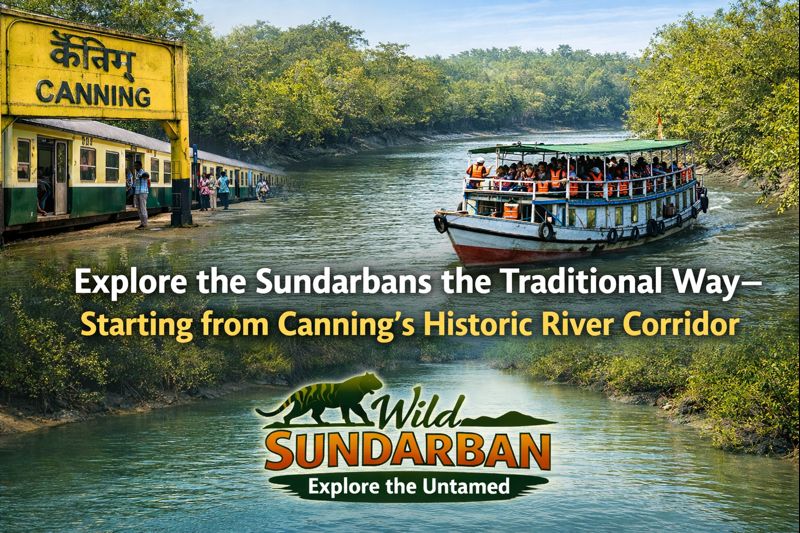
Explore the Sundarbans the Traditional Way
—Starting from Canning’s Historic River Corridor
Curated and Presented by Wild Sundarban
The Sundarbans has always been explored from the water. Long before modern highways, packaged itineraries, and mechanized tourism, the great mangrove delta was approached through rivers that carried traders, forest workers, honey collectors, and colonial surveyors deep into its shifting heart. To explore the Sundarbans in its most authentic form even today, one must follow this original logic of movement. Beginning a journey from Canning’s historic river corridor allows travelers to experience the delta as it was traditionally accessed—slowly, rhythmically, and in harmony with tides rather than timetables.
This landing page presents a detailed, research-driven explanation of why starting from Canning represents the most traditional and culturally coherent way to explore the Sundarbans. It examines geography, history, connectivity, distances, travel methods, accommodation patterns, and seasonal considerations to help travelers understand not just how to reach the forest, but how to enter it meaningfully.
Canning and the Historic River Corridor of the Sundarbans
Canning occupies a unique position at the northern threshold of the Sundarban delta, where mainland Bengal gradually dissolves into a labyrinth of tidal rivers and mangrove islands. Historically developed as a river port during the nineteenth century, Canning was envisioned as a strategic inland harbor connecting Kolkata with the deltaic hinterland. Although large-scale port ambitions eventually declined, the town retained its fundamental role as a river-oriented gateway.
A Natural Transition from Land to Water
The historic river corridor near Canning marks the point where road and rail networks yield to boat-based navigation. This transition is not merely logistical; it is experiential. Travelers sense a visible change in landscape, soundscape, and pace as freshwater channels widen, salinity increases, and mangrove vegetation becomes dominant.
Why Traditional Exploration Begins on the River
The Sundarbans is not structured around roads. Its ecology, settlement patterns, and wildlife corridors are governed entirely by water. Tigers, crocodiles, dolphins, birds, and fish all move along river edges and tidal creeks. Villages are oriented toward waterways, and livelihoods depend on daily tidal cycles. Exploring the region traditionally therefore means prioritizing river travel over road transfers.
Waterways as Ecological Pathways
Rivers in the Sundarbans function as ecological arteries. Mangrove species distribution, prey availability, and animal movement patterns are shaped by salinity gradients and tidal flow. Boat-based exploration allows travelers to observe these patterns directly, rather than encountering the forest only in fragmented pockets.
Canning as the Logical Starting Point
Canning’s significance lies in its ability to connect Kolkata efficiently with the delta’s river network. Unlike entry routes that require prolonged road journeys deep into rural areas, Canning allows a quicker and more coherent transition into water-based travel.
Strong Rail and Road Connectivity
Canning is directly connected to Kolkata by frequent suburban rail services and dependable road links. This connectivity ensures predictable arrival times, reduces travel fatigue, and enables better coordination with boat departures aligned to tidal schedules.
Major Distances When Starting from Canning
Understanding distances clarifies why Canning supports a traditional exploration model:
- Kolkata to Canning: Approximately 45–50 kilometers.
- Canning to major river jetties: Roughly 25–35 kilometers by road.
- Jetty to interior Sundarban waterways: Covered entirely by boat, depending on route and tide.
These distances allow travelers to spend a greater proportion of each day on rivers rather than highways.
How to Reach Canning
By Train
Regular suburban trains operate from Sealdah to Canning, making rail travel the most practical and environmentally responsible option. The frequency of services offers flexibility for both independent travelers and organized groups.
By Road
Canning can also be reached by road via established highways and district roads. Travel time generally ranges from one and a half to two and a half hours, depending on traffic conditions.
Important Points to See Along the Traditional Route
A Canning-based, river-oriented itinerary typically includes:
- Broad tidal rivers reflecting daily ebb and flow.
- Narrow mangrove-lined creeks where silence dominates.
- Forest watchtowers offering elevated perspectives.
- Village edges that reveal human adaptation to a forest environment.
Staying Options That Support Traditional Exploration
Accommodation associated with Canning-based routes emphasizes proximity to waterways and minimal road dependence.
Eco-Resorts Near Riverbanks
Eco-resorts located close to jetties enable early-morning departures and late-evening returns without long transfers. These properties typically emphasize local cuisine, regional materials, and nature-guided activities.
Forest-Edge Lodges
Lodges near the forest boundary allow travelers to remain immersed in the delta environment throughout their stay, enhancing both comfort and continuity.
Best Time to Explore the Sundarbans from Canning
The most favorable season for traditional Sundarban exploration extends from October to March. During these months, weather conditions are stable, temperatures are moderate, and river navigation is generally smooth.
Seasonal Perspectives
Monsoon months transform the delta into a dramatic, water-rich landscape but require experienced planning. Summer months, while warmer, still offer rewarding river journeys with appropriate scheduling.
Cultural Depth of the Canning Route
Beginning from Canning allows travelers to witness the cultural continuum of the delta. Markets, riverbanks, and boatyards reflect livelihoods shaped by tides and seasons. This exposure provides essential context for understanding the Sundarbans beyond wildlife sightings.
Why Wild Sundarban Advocates the Traditional Route
Wild Sundarban designs journeys that respect historical pathways, ecological logic, and community rhythms. Starting from Canning aligns with these values by preserving the integrity of river-based exploration and minimizing unnecessary disruptions.
Responsible Travel and Sustainability
Traditional routes inherently support responsible tourism. Reduced road travel lowers emissions, while extended river journeys distribute visitor presence across wider areas, reducing pressure on specific zones.
Exploring the Sundarbans the traditional way means honoring the rivers that have always defined it. Beginning from Canning’s historic river corridor allows travelers to experience the delta gradually, authentically, and respectfully. It is a journey shaped by water, time, and understanding—an approach that reveals the Sundarbans not as a destination to be rushed, but as a living landscape to be entered with patience.
To deepen your planning and understanding, explore resources on Sundarban Travel and curated experiences available through Sundarban Tour Packages.